Starting Your Investment Portfolio In Albuquerque And Rio Rancho
April 16, 2026
April 16, 2026
If you have been thinking about buying your first investment property in the Albuquerque area, you are not alone. Many first-time investors want a path that feels practical, not overwhelming, especially when choosing between Albuquerque and Rio Rancho. The good news is that you can start with a clear framework for property type, financing, vacancy, and local due diligence so your first deal is built on solid numbers. Let’s dive in.
Albuquerque and Rio Rancho operate within the same regional housing market, but they do not behave exactly the same way. HUD places both in the Albuquerque MSA, which includes Bernalillo, Sandoval, Torrance, and Valencia counties. That gives you one broad market with different submarkets to evaluate.
The two cities also show different population trends. According to HUD fair market rent data for the Albuquerque MSA, Albuquerque’s July 1, 2024 population estimate was 560,326, while Rio Rancho’s was 112,524. Over the 2020 to 2024 period, Rio Rancho grew 8.1%, while Albuquerque declined 0.7%.
That contrast matters because your first portfolio strategy should match the local housing stock and demand pattern. In simple terms, Albuquerque tends to offer more rental format variety, while Rio Rancho leans more heavily toward detached homes.
For most first-time investors, the best first purchase is usually one of two options: a detached single-family home or a small multifamily property with two to four units. Both can be easier to understand and finance than larger apartment assets.
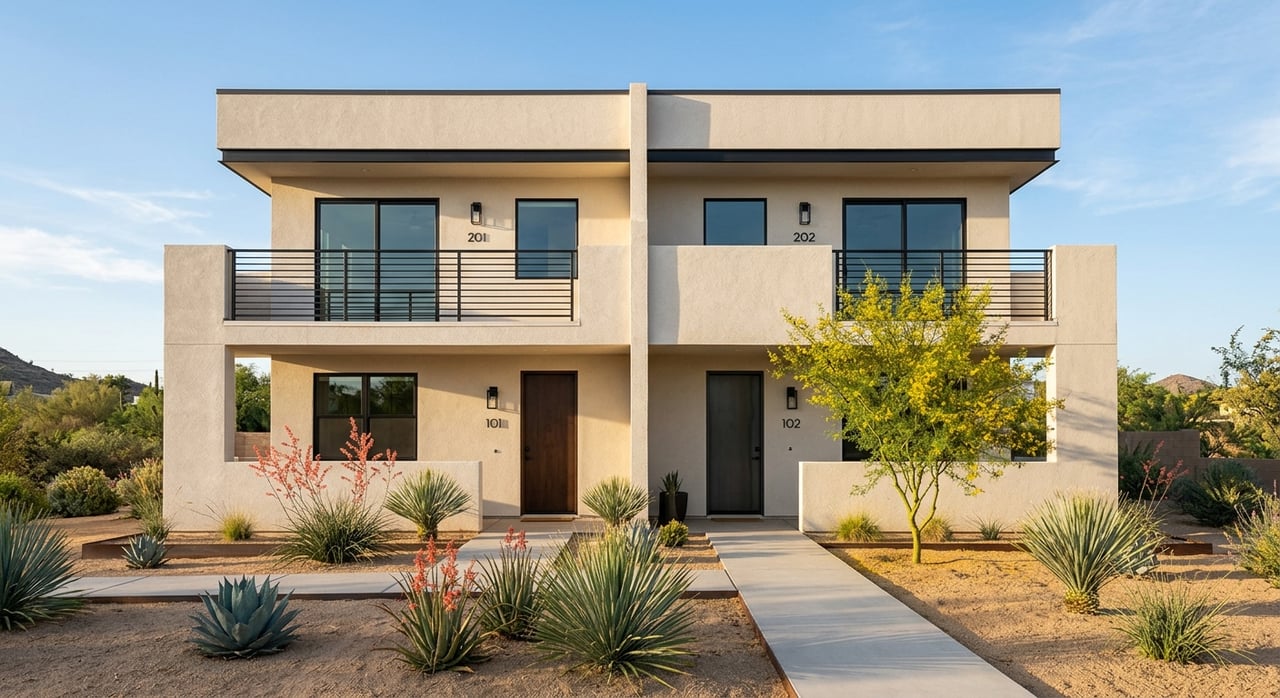
Albuquerque offers a deeper renter mix and more small multifamily opportunity. HUD found that 15% of occupied rental units in Albuquerque are in 2- to 4-unit buildings, which makes duplexes, triplexes, and fourplexes a real category to consider, not just a niche product. That can be appealing if you want to spread vacancy risk across more than one unit.
HUD also found that 41% of occupied rental units are in 5+ unit buildings in Albuquerque. Still, larger multifamily is often a more advanced move because the financing and underwriting become more commercial in nature.
Rio Rancho is a clearer fit if you want to begin with a detached single-family rental. According to U.S. Census QuickFacts for Rio Rancho, the owner-occupied rate was 82.2%, and 88.3% of occupied units were 1-unit detached housing. That points to a market where detached homes are a natural starting point for many investors.
If your plan includes cosmetic or structural updates, build extra room into your timeline and budget. The City of Rio Rancho permit guidance notes that many repairs and remodels require permits, including work involving garages, roofing, siding, windows, plumbing, mechanical systems, and electrical components.
Here is a simple way to think about each area as you shape your first portfolio purchase.
| Market | Strong starter fit | Why it stands out |
|---|---|---|
| Albuquerque | Duplex, triplex, fourplex, or single-family rental | Broader renter mix and more small multifamily inventory patterns |
| Rio Rancho | Detached single-family rental | Housing stock skews heavily toward 1-unit detached homes |
This does not mean one market is better than the other. It means your investment strategy should align with what each market naturally supports.
Before you make an offer, you need a simple underwriting formula. The basic sequence is:
This is not complicated, but it does require discipline. If you skip vacancy, underestimate expenses, or use rough tax guesses, your projected return can look much better on paper than it will in real life.
HUD’s 2026 Albuquerque MSA Fair Market Rent schedule lists these benchmark rents:
HUD also explains that fair market rents are mainly used for voucher payment standards and similar program limits. In other words, they are a benchmark, not a guaranteed lease rate for your specific property.
You should also remember that Census rent figures can include utilities and fuel costs when the renter pays them. That means you need to normalize utility treatment before comparing one rent data point to another.
A vacancy assumption is one of the easiest ways to make your numbers more realistic. HUD’s Albuquerque housing market analysis found apartment vacancy at 6.2% and single-family rental vacancy at 5.6% in early 2023.
Using a 6% vacancy allowance on a $1,464 monthly unit means about $87.84 per month is lost to vacancy. That leaves $1,376.16 in effective gross rent before expenses. At a local single-family rental average of $1,690, a 5.6% vacancy allowance is about $94.64 per month.
That may seem small at first glance, but over a year it adds up. Building in vacancy from day one helps you avoid overly optimistic projections.
Your financing options can shift quickly depending on whether you buy 1 unit, 2 to 4 units, or 5+ units. This is one reason many first-time investors begin with single-family or small multifamily assets.
According to Freddie Mac’s investment property mortgage guidance, investment-property mortgages are available for 1- to 4-unit properties, and the conforming LTV table lists up to 85% loan-to-value for a 1-unit investment property. That can make entry more approachable for some buyers.
For larger multifamily, the underwriting becomes more conservative. The same source notes that Fannie Mae’s conventional multifamily program applies to 5+ unit properties and lists up to 80% LTV, a minimum 1.25x debt-service coverage ratio, and stabilized occupancy expectations of roughly 90% for 90 days.
The practical takeaway is simple: financing gets tighter as the property gets larger and more commercial. If you are buying your first investment property, it is smart to talk with a lender before you finalize an offer so you know how the asset type affects leverage, reserves, and approval standards.
One of the most common mistakes new investors make is using a flat tax estimate across multiple properties. In New Mexico, that can lead to underwriting errors.
The New Mexico property tax overview explains that property is valued as of January 1 and notices of valuation are mailed around April 1. It also notes that county assessors and county treasurers handle local tax administration.
For properties in Bernalillo County, the county assessor determines property value for taxable property in the county. That is why parcel-level tax research matters. Instead of plugging in one citywide percentage, estimate taxes for the specific property you are considering.
Even if you are focused on one deal, broader local indicators can help you understand demand and affordability pressure. In Albuquerque, median household income is $68,317, and median gross rent is $1,145. In Rio Rancho, median household income is $89,596, and median gross rent is $1,514, according to U.S. Census QuickFacts.
The same source shows Bernalillo County’s burdened-household share was 32.6% in 2024. In the FRED series cited in the research, housing-burdened households are those spending 30% or more of income on housing. For investors, that is a reminder to stay grounded in what the market can realistically support.
If you want to keep your first investment move clear and disciplined, this framework can help:
A strong first portfolio does not start with buying the biggest property you can find. It starts with buying a property you can understand, finance, operate, and evaluate with confidence.
If you are weighing your first investment purchase in Albuquerque or Rio Rancho, working with an advisor who understands both the local market and the numbers can save you time and reduce costly missteps. The team at K2 Omni Group offers white-glove guidance for investor transactions, residential purchases, multifamily opportunities, and strategic market positioning across New Mexico.
June 4, 2026
May 28, 2026
May 21, 2026
May 14, 2026
May 7, 2026
April 23, 2026
April 16, 2026
April 9, 2026
April 2, 2026
If you are looking for a real estate company that is committed to providing its clients with the best possible experience, look no further than K2 Omni Pindrop. Contact us today to learn more!

K2 OmnI Group
Roanoke TX 76262